Toward Wholeness
Communities of faith have a significant role to play in human flourishing, especially today.
This post is part of an Eastertide series exploring questions around the value and relevancy of church, especially in the context of the very real challenges we are facing in our communities. As part of that conversation, I want to begin with a question:
When do you feel most alive?
Before you start to think this might be a trap, I’m not looking for churchy answers to this. I’m wondering what brings you joy, what lifts your spirit and leaves you feeling fully, exuberantly, alive?
So often we look to tackle problems we begin from the places that feel uncomfortable, or even downright painful. We want to restore wellness and wholeness in our lives and congregations, but we begin from the lack, rather than a vision of what is possible. Those experiences of pain and loss are very real, but that’s not where I want to start.
On last week’s episode of the Free to Be Podcast (did you know that I co-host a podcast with Rev. Lauren Applegate? You can find it here!) I answered this question by talking about spending time in nature with my family. Those times when we can walk in the woods, splash in the creek, play, and where my children have the freedom to experience the beauty of the world and their friendship with one another. I love watching them get to explore without fear and fully be themselves, with all their wild childhood wonder and energy, and I need the opportunity to breathe deeply, enjoying the pace and being present in the woods.
So, when do you feel most alive? Or, if you think back to when you were a child, what did you love to do, what brought, or brings, you joy?
In her book, The Connection Cure, Julia Holz draws five major elements of wellbeing out of her research. These components are the foundation for physical, mental, and emotional health and they are art, nature, movement, service, and belonging. So, when I look at some of the things that make me feel alive, I can see some of those elements. When we’re walking in the woods together, we’re experiencing nature, movement, and belonging. I imagine if you think about it, you can recognize one or more of these elements in your joyful experiences too.
But this, I want to remind you, is a series about the church.
When I first read Holz's work, I was immediately struck by how incredibly special our church environments are. After all, in many communities, three of those elements are present by default! Our worship services are full of art and artistic expression, through music, singing, and creative rhetoric in preaching. Many churches are also filled with pieces of art, from stained glass to paintings and Sunday School crafts decorating bulletin boards. Service is a foundational value, to one another within the congregation, and to community needs such as local food pantries, emergency shelters, and other partnerships. I know churches serving their communities through reading and tutoring programs, free dinners, backpack drives, and so many other initiatives! Belonging is enjoyed by many who have spent decades in fellowship and community with one another (though we need to have some honest conversations about expanding who belongs), and the last two elements, nature and movement, are easily incorporated not only into our environments, but into our worship!
So here, in 2026, in the midst of change and tension, communities of faith are encountering a new invitation to consider their roles within their neighborhoods and spheres of influence. I wonder, what could it look like to see the church as an institution that can contribute to the wellbeing of all the people who encounter it, perhaps through the lens of these elements. There is no need for this to diminish the tradition and values of faith within a community, but perhaps, it could offer a new channel by which our faith could expand.
Let me know, does this framework of wellbeing through movement, nature, art, service, and belonging resonate with you? How could you imagine engaging these elements in your life as an individual, or within a community context? Do you already see your congregation flourishing in one of these areas? I would love to hear about it! You're always welcome to reach out in real life, or via email at hello@mannabethlehem.com
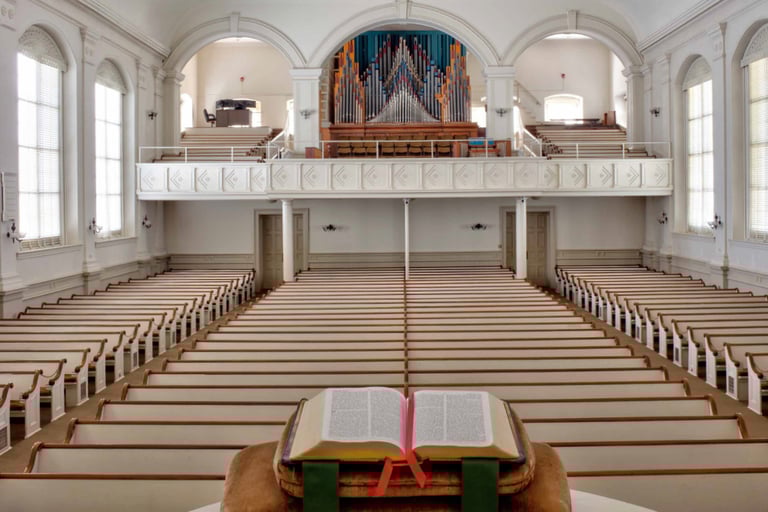
You can't convince me that the organ itself is anything less than a work of art, let alone the music that is played on it! And don't get me started on the art of architecture...
(Image from Central Moravian Church in Bethlehem, PA)


hello@mannabethlehem
(425)539-2510